



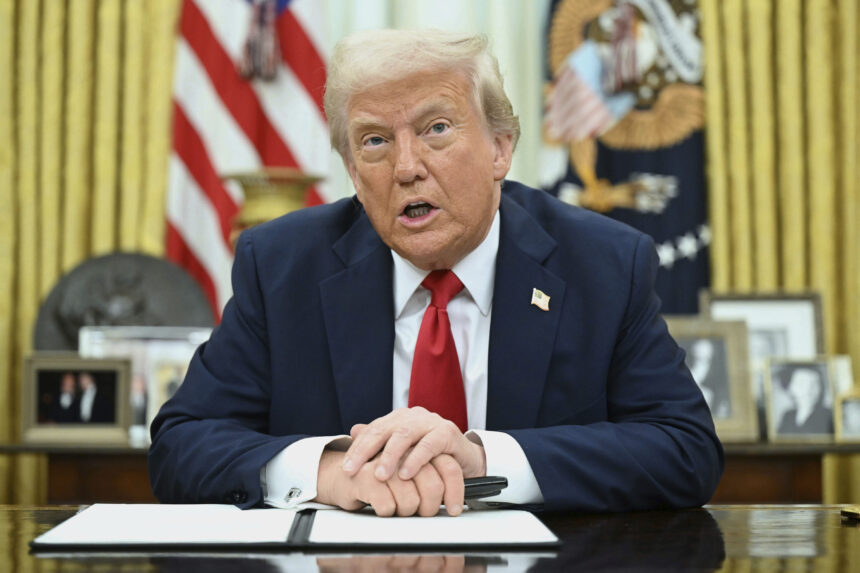

President Trump generally does not support student loan forgiveness and would likely seek an end to some student loan forgiveness programs. But can the President reverse student loan forgiveness that has already been granted? Probably not.
It’s sparked a lot of concern, though, in recent weeks, especially as Trump has dismantled key parts of the Department of Education, and just last week announced plans to reform PSLF.
President Biden provided $175 billion in student loan forgiveness for 4.6 million borrowers, more than any previous president. For borrowers that have already received forgiveness, the question looms:
Could Trump claw back student loan forgiveness that has already been granted? The answer is generally no.
Let’s break it down and learn why past loan forgiveness is likely protected, but future loan forgiveness could be in jeopardy.
Related: Every Student Loan Forgiveness Program That Exists Today
Would you like to save this?
President Trump’s Position On Student Loan Forgiveness
During President Trump’s first term, his administration proposed eliminating the Public Service Loan Forgiveness (PSLF) program. This was reflected in the annual education appendices of the President’s budgets for fiscal years 2018, 2019, 2020 and 2021.
For example, the FY2021 budget sought to replace the existing Income-Driven Repayment (IDR) plans with a new Single IDR plan that would be ineligible for PSLF. The FY2021 budget described the proposed Single IDR plan as a streamlined repayment option intended to reduce complexity.
“The 2021 Budget would replace the five current Income Driven repayment (IDR) plans with one new Single IDR plan to make choosing a repayment plan less complex. The new IDR plan would become the only income-driven repayment plan for borrowers who originate their first loan on or after July 1, 2021, with an exception for students who borrowed their first loans prior to July 1, 2021 and who are borrowing to complete their current course of study The Single IDR plan would: cap payments at 12.5 percent of discretionary monthly income while eliminating the standard repayment cap; limit loan payments to 15 years for borrowers with undergraduate debt only and 30 years for borrowers with any graduate debt—any remaining amounts owed after these repayment periods would be forgiven; calculate payments for married borrowers filing separately on the combined household Adjusted Gross Income; and eliminate Public Service Loan Forgiveness.”
Importantly, the budget proposal noted that existing borrowers would be grandfathered in, allowing those who borrowed prior to July 1, 2021, to continue accessing the original IDR plans and PSLF.
“As with the Single IDR plan, these policies would apply to loans originated on or after July 1, 2021, with an exception for students continuing to borrow to complete their current course of study.”
The language in the previous budgets was substantially similar.
The repeated efforts to eliminate PSLF were unsuccessful, primarily because Congress created these programs through legislation, and only Congress has the authority to repeal them. This highlights the limits of executive power in altering statutory programs.
In addition to budget proposals, President Trump took executive action on student loans. On August 21, 2019, he signed an executive memorandum that forgive the federal student loan debt of 25,000 disabled American veterans and established a data match between U.S. Department of Education and the Department of Veterans Affairs to streamline future student loan discharges for disabled veterans.
Following the U.S. Supreme Court decision in Biden v. Nebraska (600 U.S. 477) on June 30, 2023, which blocked President Biden’s broad student loan forgiveness plan, the Trump campaign issued a press release on July 6, 2023 praising the ruling.
“The U.S. Supreme Court handed down massive wins for the American people — halting Joe Biden’s unconstitutional student loan gimmick, restoring fairness to the college admissions process, and applying the strongest safeguards to First Amendment rights in a generation,
One thing is clear: these wins were only made possible through President Trump’s strong nomination of three distinguished and courageous jurists to the Supreme Court.”
While there are no student loan proposals on the Trump campaign website, his remarks during the September 10, 2024 Presidential Debate criticized President Biden’s efforts, calling them “a total catastrophe.” He argued that Biden’s plan misled borrowers with false hopes of debt relief, leading to frustration and disappointment among students who expected their loans to be forgiven.
“When they said they’re going to get student loans terminated and it ended up being a total catastrophe. The student loans — and then her I think probably her boss, if you call him a boss, he spends all his time on the beach, but look, her boss went out and said we’ll do it again, we’ll do it a different way. He went out, got rejected again by the Supreme Court. So all these students got taunted with this whole thing about — this whole idea. And how unfair that would have been. Part of the reason they lost. To the millions and millions of people that had to pay off their student loans. They didn’t get it for free.
…
They didn’t even come close to getting student loans. They taunted young people and a lot of other people that had loans. They can never get this approved.”
The Heritage Foundation’s Project 2025, although not formally endorsed by President Trump, contains policy recommendations that align with many of his administration’s priorities. Note that Lindsey M. Burke, author of the Department of Education chapter, has no known connection to the Trump administration.
Here are a few key excerpts from the Department of Education chapter concerning student loan forgiveness:
“The new Administration must end abuses in the loan forgiveness programs. Borrowers should be expected to repay their loans.”
“Effective July 1, 2023, the department promulgated final regulations addressing loan forgiveness under the HEA’s provisions for borrower defense to repayment (“BDR”), closed school loan discharge (“CSLD”), and public service loan forgiveness (“PSLF”). … Acting outside of statutory authority, the current Administration has drastically expanded BDR, CSLD, and PSLF loan forgiveness without clear congressional authorization at a tremendous cost to the taxpayers, with estimates ranging from $85.1 to $120 billion. The new Administration must quickly commence negotiated rulemaking and propose that the department rescind these regulations.”
“While income-driven repayment (IDR) of student loans is a superior approach relative to fixed payment plans, the number of IDR plans has proliferated beyond reason. And recent IDR plans are so generous that they require no or only token repayment from many students. The Secretary should phase out all existing IDR plans by making new loans (including consolidation loans) ineligible and should implement a new IDR plan. The new plan should have an income exemption equal to the poverty line and require payments of 10 percent of income above the exemption. If new legislation is possible, there should be no loan forgiveness, but if not, existing law would require forgiving any remaining balance after 25 years.”
“The new Administration must end the prior Administration’s abuse of the agency’s payment pause and HEA loan forgiveness programs, including borrower defense to repayment, closed school discharge, and Public Service Loan Forgiveness.”
“Consolidate all federal loan programs into one new program that a) utilizes income-driven repayment, b) includes no interest rate subsidies or loan forgiveness, c) includes annual and aggregate limits on borrowing, and d) includes skin in the game to hold colleges accountable.”
“The Public Service Loan Forgiveness program, which prioritizes government and public sector work over private sector employment, should be terminated.”
“Further, the next Administration should propose that Congress amend the HEA to remove the department’s authority to forgive loans based on borrower defense to repayment; instead, the department should be authorized to discharge loans only in instances where clear and convincing evidence exists to demonstrate that an educational institution engaged in fraud toward a borrower in connection with his or her enrollment in the institution and the student’s educational program or activity at the institution.”
“End time-based and occupation-based student loan forgiveness. A low estimate suggests ending current student loan forgiveness schemes would save taxpayers $370 billion.”
Can The President Revoke Previous Loan Forgiveness?
Could a future President claw back forgiveness that has already been provided?
No, the President cannot retroactively revoke student loan forgiveness once it has been finalized.
Once the federal government discharges a borrower’s debt and the borrower has received official notification, the forgiveness is considered permanent and final. Although the eligibility criteria for future borrowers can be changed, forgiveness that has already been provided is legally binding and typically irreversible.
Trending Article Right Now

Education Department Seeks To Change Rules For PSLF
- A new proposed negotiated rulemaking sessions is to take place focusing on PSLF and PAYE/ICR forgiveness.
- Here’s what can happen if these rules go into effect.
Legal Precedents And Court Rulings
Historically, courts have treated student loan forgiveness as sacrosanct and protected from retroactive reversal.
For instance, in the June 24, 2024 ruling in Alaska v. U.S. (Case No. 24-1057-DDC-ADM) concerning the SAVE repayment plan, the U.S. District Court for the District of Kansas described student loan forgiveness as having an “irreversible impact.”
The court cited the Eighth Circuit’s decision in Nebraska v. Biden, noting that the HEROES Act forgiveness posed irreparable harm “considering the irreversible impact the Secretary’s debt forgiveness action would have.” (Nebraska v. Biden, 52 F.4th at 1045-47, rev’g 636 F. Supp. 3d 991 (E.D. Mo. 2022))
The court used this argument to justify an injunction, emphasizing that once forgiveness is granted, it cannot be undone. The court said that you “cannot unscramble this egg…”
Similarly, in a ruling in Missouri v. Biden (Case No. 4:24-cv-00520-JAR), decided on the same day, the U.S. District Court for the Eastern District of Missouri refused to reverse any forgiveness already granted. Instead, the court limited its injunction to prevent further loan forgiveness under the disputed Final Rule’s SAVE repayment plan, reinforcing the notion that forgiveness, once provided, cannot be revoked retroactively.
Legislative And Contractual Protections
The federal government also generally does not attempt to claw back forgiveness once granted, and retroactively changing the terms of forgiveness would likely face significant legal challenges. If Congress were to pass a law repealing a forgiveness program like the Public Service Loan Forgiveness (PSLF), existing borrowers would typically be grandfathered in. Changes would apply only to “new borrowers” — defined as individuals who, on the specified date, have no outstanding federal student loan balance.
Two notable examples illustrate this approach:
- The Health Care and Education Reconciliation Act of 2010 (PL 111-152) modified the terms of the Income-Based Repayment (IBR) for new borrowers on and after July 1, 2014. It reduced the percentage of discretionary income from 15% to 10% and shortened the forgiveness term from 25 years to 20 years. [20 USC 1098e(e)]
- The Higher Education Amendments of 1998 (P.L. 105-244) restricted Teacher Loan Forgiveness to new borrowers as of October 1, 1998. [20 USC 1087j(b)]
These examples show that changes to forgiveness programs have historically been applied prospectively, not retroactively, to respect the contractual agreements already in place.
Due Process And Breach Of Contract
Retroactively removing loan forgiveness would likely violate due process and could be challenged in court under the principle of promissory estoppel, which prevents the government from revoking a promise that borrowers have relied upon. It would also likely be considered a breach of contract since all Federal loan borrowers sign a contract for the loan.
The Master Promissory Note (MPN), which borrowers sign when taking out federal student loans, outlines the specific terms and conditions under which loans may be forgiven or discharged. It explicitly references the Higher Education Act of 1965, providing a legal basis for forgiveness programs.
Key provisions in the MPN include:
- Under the REPAYE Plan, any remaining loan amount will be forgiven after you have made the equivalent of either 20 years of qualifying monthly payments over a period of at least 20 years (if all of the loans you are repaying under the plan were obtained for undergraduate study) or 25 years of qualifying payments over a period of at least 25 years (if any of the loans you are repaying under the plan were obtained for graduate or professional study).
- Under the PAYE Plan, if your loan is not repaid in full after you have made the equivalent of 20 years of qualifying monthly payments over a period of at least 20 years, any remaining loan amount will be forgiven.
- Under the IBR Plan, if your loan is not repaid in full after you have made the equivalent of 25 years of qualifying monthly payments over a period of at least 25 years, any remaining loan amount will be forgiven.
- Under the ICR Plan, if your loan is not repaid in full after you have made the equivalent of 25 years of qualifying monthly payments over a period of at least 25 years, any remaining loan amount will be forgiven.
The MPN also identifies conditions under which the loans may be discharged (forgiven), including the death discharge, total and permanent disability discharge, closed school discharge, false certification discharge, identity theft discharge, unpaid refund discharge, teacher loan forgiveness, public service loan forgiveness, and borrower defense to repayment.
Has Student Loan Forgiveness Ever Been Reversed?
In February 2024, a small number of borrowers experienced a reversal of loan forgiveness under the Public Service Loan Forgiveness (PSLF) program by MOHELA, a federal loan servicer. However, this was not a case of clawing back properly granted forgiveness; rather, the forgiveness had been granted in error due to incorrect information.
The reversal affected borrowers who had mistakenly been credited with qualifying payments they had not actually made. An audit by the U.S. Department of Education found discrepancies in the data, particularly involving incorrect dates on the borrowers’ PSLF employment certification forms. These errors resulted in borrowers receiving PSLF credit despite not meeting the eligibility requirements.
It is important to distinguish between correcting an error and a true clawback of forgiveness. In this instance, the forgiveness was reversed because it was mistakenly approved; the borrowers had not met the necessary requirements for PSLF at the time. In contrast, a clawback would involve revoking forgiveness that had been legitimately earned and granted under the applicable rules.
The federal government retains the authority to revoke loan discharges when a borrower is found to be ineligible based on the criteria in effect at the time of forgiveness. It could also revoke student loan forgiveness in cases of fraud.
This ensures that forgiveness programs are administered correctly and in accordance with the established guidelines, maintaining fairness for all borrowers who comply with the program’s requirements.
Student Loan Forgiveness Can Be Revoked For Future Borrowers
The federal government does have the authority to modify the requirements for student loan forgiveness and discharge, but these changes apply only to future borrowers.
Once a loan has been forgiven under existing rules, it cannot be revoked retroactively.
However, eligibility criteria for new borrowers can be adjusted based on the method by which the forgiveness program was established.
Changes To Statutory Loan Forgiveness (Programs Passed by Congress)
If a loan forgiveness program was created through legislation, only Congress has the power to modify or revoke it. The President cannot unilaterally eliminate statutory forgiveness provisions via executive action. To modify these programs, Congress must pass a new law, requiring a majority vote in the U.S. House of Representatives and, typically, a super-majority vote (60 votes) in the U.S. Senate to overcome a filibuster.
There are exceptions, such as the use of a budget reconciliation bill, which can pass with a simple majority vote in the Senate. However, the Byrd Rule restricts the scope of such bills to provisions that have a direct impact on the federal budget, preventing non-budgetary policy changes. Additionally, changes to Senate procedures, such as eliminating the filibuster, could alter the legislative process.
Even with proposals to end Public Service Loan Forgiveness, it won’t happen with budget reconciliation.
Examples of statutory loan forgiveness programs include:
- Public Service Loan Forgiveness
- Teacher Loan Forgiveness
- Total and Permanent Disability Discharge
- Death Discharge
- Time-based forgiveness in Income-Contingent Repayment (ICR) and Income-Based Repayment (IBR)
- Borrower Defense to Repayment
- Closed School Discharge, Identity Theft Discharge, False Certification Discharge, and Unpaid Refund Discharge
Changes To Regulation-Based Loan Forgiveness (Programs Passed via Department of Education Processes)
When loan forgiveness programs are established through federal regulations, the U.S. Department of Education can amend or repeal these regulations. This process, however, can take up to a year due to the requirements of the rulemaking process. If new regulations are published in the Federal Register by November 1, they typically take effect on the following July 1. In some cases, the Secretary of Education may expedite implementation.
Congress also has the option to block existing regulations by passing a law, though this requires legislative action. (Congress can also block new regulations within 60 legislative days under the Congressional Review Act.)
Examples of regulation-based programs include:
- Pay-As-You-Earn Repayment (PAYE)
- Revised Pay-As-You-Earn Repayment (REPAYE)
- Saving on a Valuable Education (SAVE)
While Borrower Defense to Repayment was initially established by law, the specific rules and criteria have been shaped through regulations, making them subject to modification through the regulatory process.
Changes To Executive Order-Based Loan Forgiveness
If a forgiveness policy was created via an executive order, it can be modified or revoked by a subsequent executive order. However, executive orders cannot override loan forgiveness programs established by legislation or regulations.
An example of this is the bankruptcy discharge policy for student loans. Although the standard for undue hardship in the bankruptcy discharge of student loans is codified in the U.S. Bankruptcy Code (11 USC 523(a)(8)), additional criteria, such as the Brunner Test and the Totality of Circumstances Test, were developed by the courts. In 2023, the Biden administration implemented a policy to reduce the government’s opposition to bankruptcy discharge petitions in certain cases, such as when the cost of collection exceeds the expected recovery.
This policy could be reversed by a future executive order, altering the government’s stance on bankruptcy discharges without changing the underlying law.
Related: Is Student Loan Forgiveness By Executive Order Legal?
Conclusion
In summary, once a borrower’s student loan has been discharged, the forgiveness is generally irrevocable.
Legal precedents, statutory frameworks, and contractual obligations outlined in the Master Promissory Note protect borrowers from retroactive changes.
While future legislation can modify forgiveness programs for new borrowers, existing recipients of forgiveness are typically shielded from any clawbacks or reversals.
The post Can President Trump Reverse Student Loan Forgiveness? appeared first on The College Investor.