




A reader recently asked a question that got me thinking about the intricacies of investing in the stock market:
What’s a simple yet often overlooked strategy that most investors fail to implement in their investment plan?
This is precisely the kind of question that resonates with me, as I’ve always been a proponent of simplicity in investing, whether it’s through automating your investments or adopting a long-term approach to wealth creation.
For me, simplicity is key when it comes to managing your investment portfolio and achieving your financial goals.
With that in mind, here are six straightforward ways to enhance your investment strategy and improve your overall portfolio performance:
1. Automate your investments and take a hands-off approach. This is one of the most effective and simplest ways to grow your wealth over time, by leveraging the power of compounding and avoiding emotional decision-making.
Consider automating your contributions, investment selections, asset allocation, rebalancing, savings rate increases, and dividend reinvestment. By making informed decisions upfront and avoiding frequent tweaks to your portfolio, you can minimize unnecessary risks and maximize your returns.
The less you interfere with your investment portfolio, the better off you’ll be in the long run, as you’ll be less likely to make impulsive decisions based on short-term market fluctuations.
2. Focus on the big picture. Many investors make the mistake of fixating on individual investments within their portfolios, rather than considering how they fit into the overall investment strategy.
While individual securities, funds, and asset classes are crucial components of your investment plan, it’s essential to think about how they work together in harmony. When adding new investments to your portfolio, consider how they complement your existing holdings and align with your overall financial goals.
Each component of your portfolio should serve a purpose, and collectively, they should contribute to the overall performance of your investment portfolio. It’s all about creating a cohesive investment strategy that supports your long-term objectives.
3. Consolidate your accounts. One of the most effective ways to view your portfolio as a whole is to consolidate your accounts, making it easier to track your asset allocation and overall performance.
When you have multiple accounts scattered across different financial institutions, it can be challenging to get a clear picture of your investment portfolio. I’ve personally experienced this challenge and have been working to simplify my investments by consolidating my accounts.
For instance, I recently rolled over a 403b from my wife’s previous employer into our existing retirement accounts at Schwab and Fidelity. I also moved my crypto and brokerage accounts to these platforms, making it easier to manage our investments and stay on top of our financial situation.
4. Monitor your investment performance. I have a bit of a love-hate relationship with tracking investment performance, as it’s essential to strike a balance between being informed and avoiding obsession over short-term results.
Some investors become too fixated on short-term performance metrics and benchmarks, which can lead to poor decision-making. On the other hand, it’s crucial to track your performance, especially if you’re actively managing your portfolio, to determine whether your investment strategy is working effectively.
Once a year, I conduct a back-of-the-envelope analysis to assess our portfolio’s performance, taking into account our starting value, annual contributions and distributions, and ending value. This exercise helps me stay informed and make adjustments to our investment strategy as needed.
5. Define your time horizon before investing. When it comes to making investment decisions, there are three critical variables to consider: your goals, risk profile, and time horizon.
1. Your investment objectives.
2. Your risk tolerance.
3. Your time horizon.
Failing to define your time horizon or confusing it with someone else’s can lead to costly mistakes. It’s essential to consider whether you’re making a trade, a long-term investment, or something with a defined upside or downside.
By matching your investments with a well-defined time horizon, you can avoid unnecessary mistakes and make more informed decisions when it comes to buying, selling, or holding an asset.
6. Increase your savings rate over time. The best way to generate alpha in your portfolio often comes from saving more money, rather than trying to make savvy investment decisions.
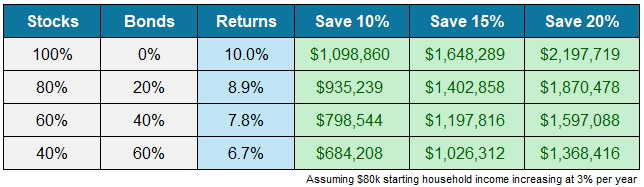
I created a chart using simple assumptions, such as median household income, historical rates of return, and inflation, and compared different asset allocations and savings rates over a 25-year period:
The results showed that saving 15% of your income resulted in a higher ending value for the 80/20 and 60/40 portfolios, compared to saving just 10% in a 100% stock portfolio. Similarly, saving 20% of your income led to better outcomes for a 40/60 portfolio than saving 10% in an all-stock portfolio.
While saving may not be the most glamorous aspect of investing, it’s a simple yet effective way to improve your portfolio’s performance over time.
I addressed this question in more detail on a recent episode of Ask the Compound:
We also discussed topics such as the 10 essential things to know about investing in the stock market, the difference between cyclical and secular markets, how bonds can impact your retirement plan, and the pros and cons of 15-year versus 30-year mortgages.