





Rational or Irrational Exuberance in the Age of AI?

Despite the government shutdown, the stock market has continued to thrive, with the S&P 500 gaining 2.3%, the NASDAQ climbing 4.7%, and the Dow rising 2.5% in the latest month. This surge in the stock market has led to questions about whether the current exuberance is rational or irrational, particularly in the context of the growing influence of artificial intelligence (AI) on the market.
The promise of AI has captivated investors, with many seeing it as a transformative force that will drive long-term growth. However, others are cautious, drawing parallels with the dot-com bubble of the early 2000s. To determine whether the current exuberance is rational or irrational, it’s essential to examine the historical context and the underlying fundamentals of the market.
Exuberance Then vs. Exuberance Now
In 1996, Fed Chair Alan Greenspan famously questioned whether markets were becoming “irrationally exuberant.” At the time, the NASDAQ was near 1,300, but it went on to soar past 5,100 over the next three years before crashing nearly 80% by 2002. However, in hindsight, the internet was not a speculative fad, but rather the foundation of a global transformation. Today, the NASDAQ stands at 23,000, an 18x increase above the 1996 level, demonstrating the long-term potential of innovative technologies like AI.
Source: Macrotrends LLC
Internet Cycle vs. AI SupercycleThe internet era has lifted the number of online users from zero to five billion, over 60% of the planet. The AI wave, which began publicly in November 2022 with the release of ChatGPT, has already led to a more than doubling of the NASDAQ in under three years. While this pace is not sustainable forever, and bubbles can form, emotions can swing, and markets can correct, dismissing AI as a fad ignores its unmistakable and accelerating impact.

With the rapid appreciation in the stock market, it’s essential for investors to identify and understand the warning signs of potential bubble bursting or market crash. Studying past crashes, such as the 1929 Great Crash, can provide valuable insights.
Not All Bubbles are Created Equal
Major market drawdowns are part of a long-term investor’s journey, including the 1929 Great Crash, the 1973-74 Nifty-Fifty, the 1987 Black Monday, the 2000 dot-com bust, the 2008 financial crisis, and the 2020 COVID crash. Many pundits are now asking if the AI surge is the next bubble.
- 1929: Great Crash
- 1973-74: Nifty-Fifty
- 1987: Black Monday
- 2000: Dot-com bust
- 2008: Financial crisis
- 2020: COVID crash
Valuations, as measured by P/E ratios, suggest a very different setup than in 2000. Today’s tech leaders are elevated but nowhere near dot-com extremes:
- NVIDIA Corporation (NVDA): 57x
- Apple Inc. (AAPL): 36x
- Microsoft Corp. (MSFT): 36x
- Alphabet Inc. (GOOG): 32x
- Amazon.com, Inc. (AMZN): 31x
- Meta Platforms, Inc. (META): 23x
*Source: MarketSurge – only Tesla, Inc. (TSLA) has a P/E higher than 100x.
For the S&P 500 overall, the index has a forward P/E of 22.8x (Yardeni Research), significantly lower than 2000 levels and nowhere near bubble territory.
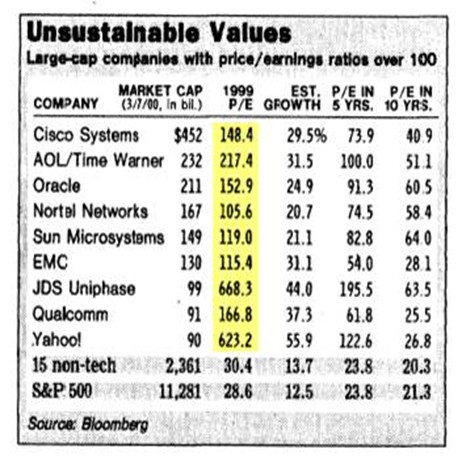
Source: Wall Street Journal – March 14, 2000
Life After the Internet and Life After AI Introduction
Reflecting on the past 25 years, it’s clear that the internet has revolutionized daily life, from renting movies at Blockbuster to driving to the bank for deposits. AI is set to reshape daily life on an even faster timeline, from medicine and logistics to entertainment and marketing.
Personal experiences with AI have been transformative, from creating a beautiful Mother’s Day poem to writing an obituary with the help of AI. These “AI epiphanies” are becoming a regular occurrence, demonstrating the potential of AI to amplify human output and productivity.
- With a few prompts, I created a beautiful Mother’s Day poem and became a poet hero despite never writing poetry before.
- When I recently needed to write an obituary for my mother, AI helped structure and refine it in minutes instead of taking me hours.
- Just last month, I needed to hunt down lobster bisque for a shrimp pasta recipe I wanted to make. It turned into a time-wasting scavenger hunt. Thankfully, AI found it in stock, even when multiple apps insisted it wasn’t available.
And when it comes to investing, AI can help evaluate biotech companies in days without sacrificing rigor, amplifying output and productivity.
Not All AI Stories Are “Unicorns and Rainbows”
While AI boosts productivity, it also means some companies need fewer people. Amazon recently announced 14,000 layoffs despite reporting amazing financial results. Microsoft and Meta have also announced thousands of employee layoffs even as profits rise. This isn’t doom and gloom — it’s innovation cycles in action, where technology displaces tasks before ultimately creating new industries and roles.
So… Rational or Irrational?
Although there has been much debate regarding whether we are in an AI bubble, from my perspective, we are in the very early innings of a long AI revolutionary game. There are definitely pockets of frothiness that expose investors to undue risk, but if you can follow a disciplined, diversified, valuation-sensitive investment strategy, like we implement at Sidoxia Capital Management, I feel that the current exuberance is more rational than irrational.
Wade W. Slome, CFA, CFP®
Plan. Invest. Prosper.
This article is an excerpt from a previously released Sidoxia Capital Management complimentary newsletter (Nov. 3, 2025). Subscribe Here to view all monthly articles.
DISCLOSURE: Sidoxia Capital Management (SCM) and some of its clients hold positions in NVDA, AAPL, MSFT, GOOGL, AMZN, META, TSLA, and certain exchange-traded funds (ETFs), but at the time of publishing had no direct position in any other security referenced in this article. No information accessed through the Investing Caffeine (IC) website constitutes investment, financial, legal, tax, or other advice nor is to be relied on in making an investment or other decision. Please read disclosure language on IC Contact page.
Entry filed under: Behavioral Finance, Earnings, economy, Financial Markets, Financial Planning, Government, inflation, International, Stocks, Trading. Tags: ai, ai stocks, bubble, economy, exuberence, Federal Reserve, finance, investing, irrational exuberance, NASDAQ, Politics, Sidoxia, stock market, Stocks, tech stocks, Wade Slome.