




Just like the rings of a tree trunk reveal its history, a simple stock chart can be a powerful tool for understanding market trends and making informed investment decisions.
Each line on the chart represents a year in the market’s life, with fat lines indicating periods of rapid growth and thin lines signifying times of drought or economic downturn. By analyzing these charts, investors can gain valuable insights into the market’s behavior and make more informed decisions about their portfolios.
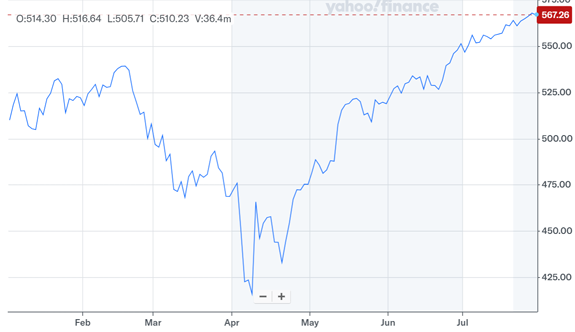
Take, for example, the recent performance of the Nasdaq, as tracked by the QQQ ETF. A closer look at the chart reveals a story of rapid growth, followed by a sudden decline, and then a steady recovery.
To better understand this trend, let’s examine the chart in more detail. As you can see from this morning’s screenshot, the QQQ ETF has experienced a significant surge in recent months, driven in part by the strong performance of tech stocks.

Source: Yahoo Finance
This chart tells us everything we need to know about the 2025 market so far, including the impact of tariffs, the inauguration, and the subsequent market volatility. By analyzing these trends, investors can gain a better understanding of the market’s behavior and make more informed decisions about their investments.
We started the year on a high note, with the market maintaining its momentum until the first hints of tariffs appeared, followed by Trump’s “Liberation Day” in early April. However, this was followed by a significant decline, as investors panicked and some even feared the onset of a new Great Depression.
I wasn’t one of them, though. After the big sell-off, I advised my readers that this was one of the best buying opportunities we’ve had since COVID, driven in part by the growing demand for tech stocks and AI-themed ETFs.
Fast forward to today, and the Nasdaq is at an all-time high, with the market revealing a growing divide between institutional investors and retail investors. While hedge funds are offloading tech stocks at the fastest pace in over a year, everyday investors are pouring money into these stocks at a record pace.
According to Goldman Sachs, hedge funds are rotating into defensive sectors like consumer staples, health care, and utilities, while retail investors are driving the demand for tech stocks and AI-themed ETFs. This trend is shaping up to be the widest divergence between institutional caution and retail conviction since the post-COVID rally.
So, why is the market still grinding higher? Let’s unpack what’s really happening and explore the implications for investors. The answer lies in the growing demand for tech stocks and AI-themed ETFs, driven in part by the increasing adoption of AI technology and its potential to boost profit margins across industries.
Wall Street Retreats While Main Street Charges Forward
Hedge funds are cutting their long tech exposure at the fastest rate in 12 months, with over $45 billion in U.S. equity exposure shed over the past 30 days. Much of this came from the same tech and AI names that powered the rally earlier this year, including companies like Nvidia and Tesla.
A Goldman Sachs client note seen by Reuters confirms that last week’s pullback is the steepest in a year, spanning chipmakers, software firms, and IT services across North America and Europe. Exposure to tech and media stocks has dropped to a five-year low, with some funds now shorting the sector outright.
This reflects a bigger trend dating back to early 2025, when Goldman first warned about intense global equity sell-offs across sectors due to tariff concerns. The sudden pullback is largely driven by the fact that some big tech names are trading at 30%+ premiums to their 10-year averages, making them vulnerable to a correction.
With tariffs back on the table and the Fed still unsure about rate cuts, many fund managers are worried about inflation creeping back into the picture. This has led to a shift into defensive stocks that can ride out uncertainty, such as consumer staples and health care.
In contrast, retail investors are driving the demand for tech stocks and AI-themed ETFs, with JPMorgan estimating that individuals poured $270 billion into U.S. equities in the first half of 2025. This trend is expected to continue, with another $360 billion projected to be added by year-end, making it over $600 billion in “grassroots” capital expected to flow into the market this year.
The average retail investor today is 33 years old, using mobile platforms like Robinhood and Webull, and is increasingly financially savvy. However, they are also susceptible to “social contagion,” where a single Reddit thread or TikTok clip can trigger a wave of buying, often driven by momentum rather than fundamentals.
This trend is not limited to tech stocks, with retail investors also driving the demand for AI-themed ETFs. As AI technology continues to advance and its potential to boost profit margins across industries becomes more apparent, we can expect to see even more demand for these types of investments.
But is this trend sustainable? With retail traders now accounting for nearly 21% of daily U.S. equity volume, up from just 10% a decade ago, it’s clear that they are having a significant impact on the market. However, it’s also important to remember that the market can’t run on momentum forever, and a correction is inevitable.
Here’s My Take
I recently told Extreme Fortunes readers that this market feels like a “grind higher,” with momentum taking over and retail investors keeping the rally going. Hedge funds are sitting on the sidelines for now, watching this rally unfold without them, but if retail investors keep buying, it could add another 5% to 10% upside for the S&P 500 in the months ahead.
So far, earnings have been decent, the Fed is in wait-and-see mode, and AI implementation is boosting profit margins across industries. However, we’re heading into the fall, which is historically one of the weakest stretches for stocks, and if any of Trump’s tariffs start to hit consumer prices, or if the Fed situation gets dicier than it already is, we could see the current bullish sentiment turn bearish fast.
After all, the market can’t run on momentum forever, and that could be a big problem for today’s high-flying tech stocks. As an investor, it’s essential to stay informed and adapt to changing market conditions, using tools like stock charts and market analysis to make informed decisions about your portfolio.
Regards,

Ian King
Chief Strategist, Banyan Hill Publishing
Editor’s Note: We’d love to hear from you! If you want to share your thoughts or suggestions about the Daily Disruptor, or if there are any specific topics you’d like us to cover, just send an email to dailydisruptor@banyanhill.com.
Don’t worry, we won’t reveal your full name in the event we publish a response. So feel free to comment away!